This page compares product categories, but it does not verify one exact marketplace listing. Treat the cards below as prompts for label checking, not as rankings or buying advice.
What a CGM is and how it relates to PCOS
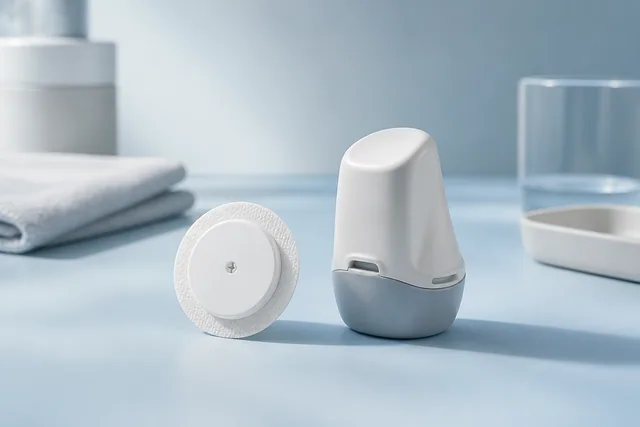
CGM stands for continuous glucose monitor. It is a small sensor worn on the skin that reads the glucose level in the fluid just under the skin every few minutes, then sends those readings to a phone or reader. Compared with a standard finger-prick test that gives one reading at a time, a CGM shows patterns across the day and night.
Many people living with PCOS have insulin resistance, which is why some want to understand their glucose patterns after meals or while sleeping. A CGM can show these patterns, but it is important to understand that a CGM is not a tool for diagnosing PCOS and is not a replacement for clinical blood tests such as fasting glucose or HbA1c. A CGM shows numbers rising and falling, but what those numbers mean for your body is a conversation with a doctor, not a conclusion you draw alone.
What this comparison can and cannot do
It can help you ask better questions about a device: how accurate its readings are reported to be, what it can and cannot measure, how long a single sensor lasts before it has to be replaced, what replacement sensors cost over time, how easy it is to wear and read each day, whether your skin is comfortable with it, and whether the device has local registration proof you can check.
It cannot prove that a device is genuine, the current model, registered, or suitable for your health situation. Nor can it interpret what a reading means for your body, especially if you are pregnant, breastfeeding, trying to conceive, taking hormonal treatment, or living with diabetes, a thyroid condition, liver disease, or kidney disease. That interpretation needs health context and professional advice where relevant.
How the CGM options differ
Different CGM brands differ in how long a single sensor lasts before it has to be replaced, whether it needs calibration with finger-prick tests, the reported accuracy, and whether alerts can be set for high or low readings. Some systems require you to scan the sensor manually to get a reading, while others push readings automatically.
What every system can tell you is the direction and pattern of glucose in the fluid under the skin. What none of them can tell you is the cause of that pattern, whether you have PCOS, or what next step is appropriate. Readings from the fluid under the skin also lag slightly behind glucose in the blood, so a real-time number is not as exact as a lab test. Small differences between brands do not mean one brand is better for you; they mean each one has limits worth understanding.
Option to check
Products to check
How to choose the right device for your goal
Start with your actual goal, not brand popularity. Ask what you genuinely want to see: do you want to understand glucose patterns after meals for a few weeks only, or do you think you need long-term monitoring? A CGM only shows glucose patterns in the fluid under the skin; it is not a clinical blood test and not a tool for diagnosing PCOS. If your goal is really a clinical answer such as fasting glucose or HbA1c, a CGM does not replace it.
Then compare the features that matter for that goal. Note how long a single sensor lasts, whether it needs calibration with finger-prick tests, the reported accuracy, whether readings are pushed automatically or have to be scanned, whether high and low alerts can be set, and whether the app it needs supports your phone. If one seller offers several models, make sure you are comparing the exact model you would receive, not a different version.
What not to assume
Check the real label, dose, seller, halal certificate, and registration before buying, and choose a product whose details are clear.
Do not treat a sensor reading as a diagnosis. A single high reading after a meal or a single low reading at night does not necessarily mean something serious, and a real-time number from the fluid under the skin lags slightly behind glucose in the blood. If you take diabetes medicine, hormonal treatment, or other medicine that affects blood sugar, what a pattern means is best discussed with your doctor rather than interpreted alone from the device display.
What to think about before buying
Cost is a major consideration with a CGM because the sensor is a consumable replaced regularly. The real cost is not the price of the reader alone but the running cost of replacement sensors over time. Think too about whether you are comfortable wearing a sensor on the skin, whether your skin reacts easily, and whether the phone app it needs supports your phone.
Consider your actual goal as well. If you only want to understand patterns for a few weeks, your needs may differ from long-term use. Ask yourself whether this data will genuinely help a decision you and your doctor make, or whether it would only add worry about numbers without context.
The Malaysia angle on product registration
Medical devices in Malaysia are regulated, and it is worth checking whether the device you are considering is registered with the local medical-device authority. Legitimate sellers can usually show registration details when asked. If a seller offers an imported device with no registration proof at all, that is a question to weigh before buying, not something to assume is safe.
How to check a registration number
If a seller shows a medical-device registration number, you can check it against the local medical-device authority database rather than trusting the image on a sales page. Match the brand name, model, and manufacturer to the record shown. If the number finds no record, or if the name on the record differs from the product being sold, that is a sign to weigh. Note the date you checked, because records and product listings can be updated over time.
What a CGM cannot tell you
A CGM reading shows a glucose pattern, but it does not explain the cause. A high reading after a meal does not necessarily mean something serious, and a single low reading at night is not automatically a problem. Sensors can also be off occasionally, especially on the first day after insertion. A single reading rarely means much; the pattern across several days is more useful, and interpreting it needs health context only your doctor can provide.
What to bring to a doctor
If you want to discuss a CGM with a doctor, bring concrete information. List your current medicines, any chronic conditions, and pregnancy or breastfeeding status if relevant. If you already use a sensor, bring the pattern data exported from the app, not just one reading that worried you. Write down your real questions first, such as whether this pattern is relevant to your care and whether a formal blood test is more suitable. A conversation guided by real data is usually more useful than general worry about numbers.
A CGM is an optional tool, not a requirement
It is worth remembering that a CGM is one optional tool, not something required to manage PCOS. Many people manage their condition well without ever wearing a sensor. A CGM may appeal to some who want to understand their body’s patterns, but a flood of data without professional interpretation sometimes adds confusion rather than clarity. Interpretation is most appropriate with a doctor who knows your health history.
A practical next step
Choose one option to discuss, not a bundle. Bring the label to a pharmacist or doctor and ask: is this category relevant to my goal, does it overlap with my medicines, what side effects should I watch for, and when should I stop or review? For the wider process, read how to check PCOS supplements and what PCOS and PMOS mean.