This page compares product categories, but it does not verify one exact marketplace listing. Treat the cards below as prompts for label checking, not as rankings or buying advice.
What an OPK is and how it relates to PCOS
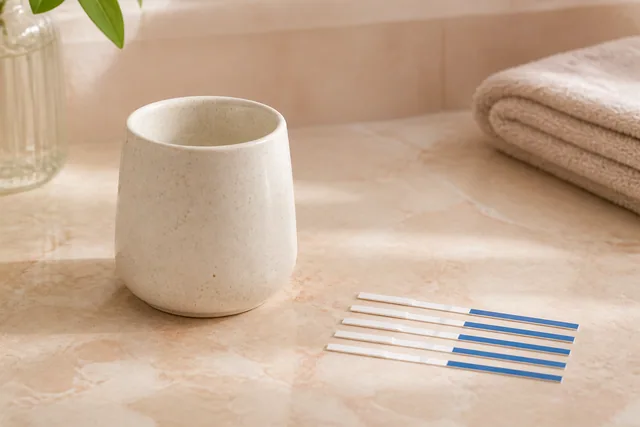
OPK stands for ovulation predictor kit. An OPK strip is a urine test that detects a surge of the hormone LH, which usually rises shortly before ovulation. Some people use these strips to try to identify the most fertile window in their cycle.
For someone living with PCOS, this method has an important limit. LH levels can stay elevated much of the time in some people with PCOS, so a strip may show a positive result repeatedly even when ovulation is not happening. An OPK strip only detects an LH surge; it does not confirm that ovulation actually completed. In other words, a positive result means the hormone rose, not a guarantee that an egg was released. An OPK is an observation tool, not a tool for diagnosing PCOS.
What this comparison can and cannot do
It can help you ask better questions about a device: how accurately and sensitively it is reported to detect LH, what it can and cannot confirm, how many strips come in a pack and the cost per unit, how often strips have to be replaced, whether results are read by eye or through a digital reader, the expiry date of the strips, and whether the device has local registration proof you can check.
It cannot prove that a device is genuine, the current model, registered, or suitable for your health situation. Nor can it interpret what a result means for your body, especially in PCOS where LH levels are already erratic, or if you are pregnant, breastfeeding, trying to conceive, or taking hormonal treatment. That interpretation needs health context and professional advice where relevant.
How the strip options differ
Different OPK strips differ in how many strips come in a pack, whether results are read by eye or through a phone app, the reported sensitivity to LH, and whether there is a digital reader rather than lines on a paper strip. Some brands sell large packs that are cheap per unit, while others include a digital reader that interprets the lines for you.
What every strip can tell you is whether LH in the urine is at a level counted as high at the time of the test. What none of them can tell you is whether ovulation actually completed, exactly when it happened, or the cause of an irregular cycle. For PCOS, many strips can give confusing results because LH levels are already erratic. The difference between brands is more about ease of reading and cost per unit than the basic limit of the method.
Option to check
Products to check
How to choose the right device for your goal
Start with your actual goal, not brand popularity. Ask what you genuinely want to do: do you want to test on many days at a low cost per unit, or would you prefer a digital reader that interprets the lines for you? An OPK strip only detects an LH surge; it does not confirm that ovulation actually completed, and it is not a tool for diagnosing PCOS. If your goal is really certainty about your cycle, a strip does not replace a blood test or a scan.
Then compare the features that matter for that goal. Note how many strips come in a pack and the cost per unit, the reported sensitivity to LH, whether results are read by eye or through a digital reader, the expiry date of the strips, and whether you need a phone compatible with the app. For PCOS with irregular cycles you may need to test on many days, so consider the total number of strips you would use, not the price of one pack alone.
What not to assume
Check the real label, dose, seller, halal certificate, and registration before buying, and choose a product whose details are clear.
Do not treat a positive result as certainty. A strip only detects the hormone, not the event of an egg being released, and in some people with PCOS a baseline LH level that stays high much of the time can produce repeated positive results even when ovulation is not happening. What a result means is best discussed with your doctor rather than interpreted alone as a sign of pregnancy or not.
What to think about before buying
Consider the real cost, which is the cost of replacement strips over time, not the price of one pack. For PCOS with irregular cycles, you may need to test on many days, so a large pack that is cheap per unit can sometimes end up more expensive if most strips give no certainty. Think too about the expiry date of the strips, how easy results are to read, and whether you need a digital reader or a phone that is compatible with the app.
Consider whether the effort of testing daily fits your situation. For some people with PCOS, repeated positive results without certainty can add worry. Ask yourself whether this information will help a decision you and your doctor make, or whether a clinical assessment is more suitable for your situation.
The Malaysia angle on product registration
Test kits in Malaysia fall under medical-device rules. It is worth checking whether the product you are considering has registration proof that can be verified. A legitimate seller can usually provide this when asked. If a seller offers imported strips with no registration proof at all, that is a question to weigh, not something to assume is safe.
How to check a registration number
If a seller shows a medical-device registration number for a test kit, you can check it against the local medical-device authority database rather than trusting the image on a sales page. Match the brand name, model, and manufacturer to the record shown. If the number finds no record, or if the name on the record differs from the product being sold, that is a sign to weigh. Note the date you checked, because records and product listings can change over time.
Why positive results can mislead in PCOS
OPK strips detect an LH surge that usually rises sharply just before ovulation. In some people with PCOS, the baseline LH level is simply higher much of the time, so a strip can show a positive result on many days in a row even when ovulation is not happening. This is not because the strip is faulty; it only detects the hormone, not the event of an egg being released. A single positive therefore rarely gives certainty in PCOS, and repeated positives can add confusion rather than clarity.
What to bring to a doctor
If you want to discuss fertility with a doctor, bring concrete information. List your cycle length if you know it, your current medicines, any chronic conditions, and whether you are trying to conceive. If you already test with strips, bring a record of results across several cycles, not just one day. Write down your real questions first, such as whether these results mean anything for your situation and whether a blood test or scan is more suitable. A conversation guided by real records is usually more useful than general worry about the lines on a strip.
An OPK is an optional tool, not a requirement
It is worth remembering that an OPK strip is one optional tool, not something required. For the irregular cycles common in PCOS, the LH surge is often hard to interpret and repeated positive results can mislead. Some people are better served by other observations or a clinical assessment. The interpretation of fertility patterns is best done with a doctor who knows your cycle history.
A practical next step
Choose one option to discuss, not a bundle. Bring the label to a pharmacist or doctor and ask: is this category relevant to my goal, does it overlap with my medicines, what side effects should I watch for, and when should I stop or review? For the wider process, read how to check PCOS supplements and what PCOS and PMOS mean.